Gridloop.AI
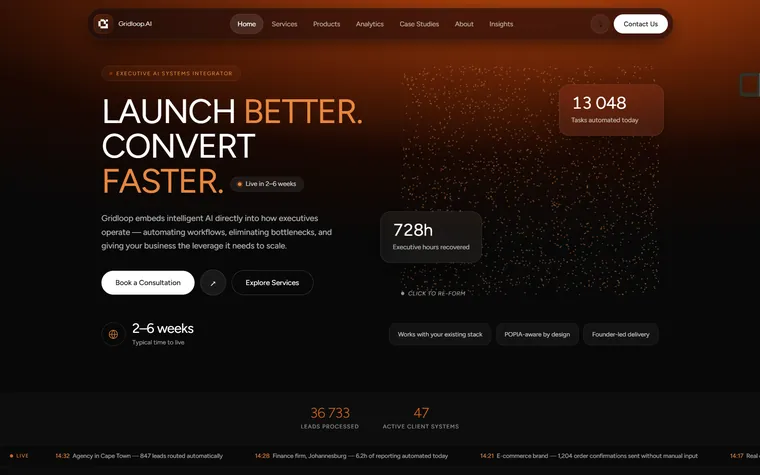
Custom AI automation for South African businesses — workflow automation, CRM integration and executive AI systems. A hand-built, conversion-focused site engineered to turn technical capability into booked consultations.
View the build →AI Automation & Systems · South Africa
Most businesses do not need artificial intelligence. They need the same four things to stop being done by hand every week. That is where automation actually pays — and it is a far shorter road than the pitch decks suggest.
The automation that earns its cost back is almost never the impressive one. It is the quote that gets retyped into three systems, the enquiry that sits unanswered overnight, the report someone rebuilds every Monday morning.
We start by finding where your team's hours actually go. Frequently the answer is not AI at all — it is two systems that should be talking to each other and are not. We will tell you that rather than selling you a model you do not need.
Where AI genuinely helps is in the messy middle: reading unstructured documents, drafting first-pass responses, classifying and routing incoming work, summarising long threads into something a human can act on in seconds.
Where do the hours go? Usually it is data re-entry and chasing, not anything that needs a model.
CRM, email, forms, accounting, spreadsheets. Most of the win is here, before AI enters the picture.
Document reading, drafting, classification, routing, summarising. Targeted, not sprayed across everything.
Anything touching money, contracts or client commitments gets approved by a person. Always.
An automation that works in a demo and breaks on the edge cases is worse than no automation, because someone now has to check it as well as do the work.
So we build with failure in mind: what happens when the input is malformed, the API is down, or the model is confident and wrong. Anything touching money, contracts or customer commitments gets a human approval step. Speed is not worth the risk of an automated system agreeing to something on your behalf.
We also build so you are not trapped. You should be able to see what runs, change it, and switch it off without calling us.
We built the site for an AI automation consultancy — so this is a category we work in from both sides.
Custom AI automation for South African businesses — workflow automation, CRM integration and executive AI systems. A hand-built, conversion-focused site engineered to turn technical capability into booked consultations.
View the build →More than most expect, and less excitingly than the marketing suggests. Lead capture and routing, quote and invoice generation, follow-up sequences, data moving between systems, report assembly, document processing and first-pass drafting are all well within reach. The test is whether a task is repetitive and rule-shaped — if it is, it is a candidate.
No, and if you do then it was built wrong. We hand over systems your team can see, adjust and switch off. We document what runs and why. Automation that only the agency understands is a dependency, not an asset.
It scales with how many systems have to talk to each other and how messy the data is. Connecting two clean systems is a small project. Automating a process that currently lives in someone's head and three spreadsheets takes longer, because the first job is working out what the process actually is. We scope it after seeing how you work.
It has to be designed for, not assumed. We are explicit about where data goes, which services process it, what is retained and what is not. For sensitive work there are approaches that keep data inside your own systems. If a vendor cannot tell you plainly where your data travels, that is your answer.
It will, occasionally — that is a design constraint, not a bug to be surprised by. Anything consequential gets a human approval step, and we build the failure paths deliberately: what happens on malformed input, on an outage, on a confident wrong answer. The goal is a system that degrades safely rather than one that is right most of the time and silently wrong the rest.
With the task your team complains about most. It is almost always the right first target — high frequency, well understood, and the improvement is obvious to everyone. Start there, prove the value, then expand.
Tell us the task that eats the most time. We will tell you whether it is worth automating — including when it isn't.